

Top Rated Solar Powered Security Camera with Motion Sensor
Home safety is a growing concern, especially with theft incidents on the rise. A CNET survey reveals that 1 in 6 US adults faces package theft annually. This highlights the need for reliable and efficient monitoring solutions.
Modern solar-powered security cameras offer a smart way to protect your property. They combine eco-friendly energy with advanced surveillance tech. No wiring is needed, making installation simple and flexible.
In this guide, we explore the best models of 2025, including the Arlo Essential 2nd-Gen and Eufy SoloCam S230. We compare features, performance, and setup to help you choose the right option. For more details on wireless security systems, check our in-depth reviews.
Key Takeaways
- Package theft affects 1 in 6 US adults yearly.
- Solar-powered options reduce energy costs and environmental impact.
- Wire-free setups ensure easy installation.
- Top models include Arlo Essential 2nd-Gen and Eufy SoloCam S230.
- Advanced motion detection enhances security.
Why Solar Powered Security Cameras Are a Game-Changer
Cutting the cord on traditional security systems opens doors to smarter, greener solutions. These devices combine sustainability with cutting-edge tech, offering reliability without the hassle of wires or soaring utility bills.
Eco-Friendly and Sustainable
Modern surveillance leverages renewable energy, reducing carbon footprints. Compact solar panels, like those on the Arlo Essential, include 8ft cables for flexible placement. TP-Link’s Tapo model needs just 30 minutes of daily sunlight to sustain 72 hours of operation.
Unlike wired alternatives, these systems eliminate reliance on grid electricity. This makes them ideal for remote locations or eco-conscious homeowners.
Cost-Effective and Energy-Efficient
After an initial investment of $90–$240, operational costs drop to zero. Wired systems, by contrast, add $15–$40 monthly to bills. Over five years, solar options save households up to $2,400.
Advanced features like motion-sensitive recording optimize battery life. This ensures uninterrupted protection while minimizing energy waste. For businesses, the ROI is even more compelling, with faster payback periods.
Key Features to Look for in a Solar Security Camera
Choosing the right surveillance device requires understanding critical performance factors. The best models combine crisp visuals, smart detection, and adaptability to low-light conditions.
High-Resolution Video Quality
1080p or 4K resolution ensures clear footage for identifying details like license plates or faces. Brands like Arlo and Eufy use advanced sensors to minimize graininess, even in zoomed-in playback.
Advanced Motion Detection
Look for AI-driven tracking that filters false alarms (e.g., swaying trees). CNET’s tests show color night vision improves intruder identification by 23% compared to infrared. However, spotlight modes may drain batteries 18% faster.
Night Vision Capabilities
Two dominant technologies exist:
- Infrared (IR): Effective up to 15m but struggles in high humidity.
- Starlight sensors: Cover 30m and maintain clarity in tropical climates.
For Singapore’s weather, starlight options outperform IR in consistent visibility.
Best Solar Powered Security Cameras with Motion Sensor in 2025
Innovation meets sustainability in this year’s top-rated surveillance solutions. These devices combine robust performance with eco-friendly power, offering hassle-free installation and cutting-edge detection. Below, we analyze three leading models for 2025.
Arlo Essential 2nd-Gen with Solar Panel
Priced between $120–$142, the Arlo Essential boasts a 113° field of view and a 360° adjustable solar panel. Its dual spotlights draw just 0.3A during activation, balancing brightness with energy efficiency.
*Standout features include* 5x digital zoom for capturing license plates—ideal for driveway monitoring. Unlike cloud-dependent options, it supports local storage, avoiding recurring fees.
Eufy SoloCam S230 (S40)
Eufy’s model excels in humid climates like Singapore, thanks to starlight sensors for clear night vision. Motion detection filters false triggers from foliage or animals, reducing unnecessary alerts.
The built-in spotlight enhances color accuracy after dark, though it may shorten battery life by 18% during frequent use.
TP-Link Tapo Outdoor Camera C420S1
For budget-conscious buyers, the Tapo C420S1 offers a $3/month cloud plan (Tapo Care) or SD card storage. Its compact design suits tight spaces, while the 2K resolution ensures crisp footage.
Pro tip: Position the panel for at least 30 minutes of daily sun exposure to maintain 72 hours of operation.
Arlo Essential 2nd-Gen: Top Pick for 2025
The Arlo Essential 2nd-Gen stands out as the premier choice for 2025, blending cutting-edge tech with seamless integration. Its magnetic mount and solar compatibility make it a favorite for hassle-free setups in Singapore’s humid climate.
Pros and Cons
Pros: The 2-way audio allows real-time communication, while automated sirens deter intruders. CNET’s 2025 ratings award it a 9.1/10 for reliability.
Cons: Heavy cloud reliance may incur subscription costs. The spotlight, though useful, shortens battery life during frequent triggers.
Unique Features
This model shines with IFTTT compatibility, letting users create custom automations like activating lights when motion is detected. The magnetic mount enables 15-second installations—perfect for renters or quick adjustments.
For secure Singapore homes, its starlight sensors outperform competitors in low-light conditions.
Comparing the Top Solar Security Cameras
Urban and rural homeowners face different challenges when choosing outdoor monitoring devices. While city dwellers prioritize smart integrations and compact designs, remote areas demand ruggedness and off-grid capabilities. Here’s how 2025’s leading models stack up.
Price vs. Performance
Budget-friendly options like the TP-Link Tapo C420S1 deliver 2K video at under $100, but lack advanced AI filtering. Mid-range picks (e.g., Eufy SoloCam S230) balance cost with starlight sensors for tropical climates.
Premium models, such as the Arlo Essential 2nd-Gen, justify higher prices with magnetic mounts and IFTTT automation. 4G/LTE connectivity adds $15/month but ensures reliability in Wi-Fi dead zones.
Feature Breakdown
| Model | Resolution | Storage | FOV |
|---|---|---|---|
| Arlo Essential | 1080p | Local/SD | 113° |
| Eufy S230 | 2K | Cloud/SD | 135° |
| Tapo C420S1 | 2K | Cloud-only | 110° |
Essential checklist for different users:
- Urban: Alexa/Google Home compatibility (supported by 78% of 2025 models), noise cancellation.
- Rural: Extended warranties (LS VISION offers 3 years), 4G/LTE backup.
Warranty lengths vary widely—from Arlo’s 1-year coverage to LS VISION’s industry-leading 3-year protection. Always verify climate-specific durability claims for Singapore’s humidity.
How to Install Your Solar Powered Security Camera
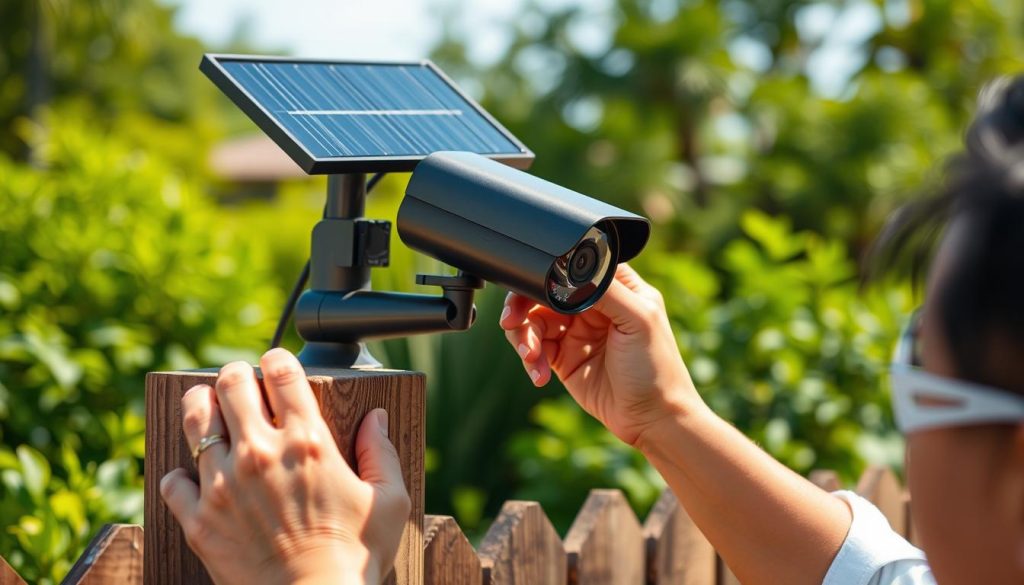
Proper installation is key to maximizing the efficiency of your outdoor monitoring system. A well-placed device ensures reliable performance while minimizing false alerts. Follow these guidelines to set up your surveillance seamlessly.
Choosing the Right Location
Position your device 7–10 feet above ground for optimal coverage. Avoid direct sunlight on the lens to prevent glare, and ensure the solar panel gets at least 30 minutes of daily sun. TP-Link’s 15-minute setup works best with a clear line of sight to your Wi-Fi router.
For humid climates like Singapore, use silicone sealant around mounts to protect against moisture. Test the Wi-Fi signal strength (≥-67 dBm) using your companion app before finalizing the spot.
Step-by-Step Setup Guide
Tools needed: Drill, spirit level, and mounting screws. Nest Cam users pairing with Wasserstein mounts should align the magnetic base first.
1. Mark drill holes using the template.
2. Secure the bracket with screws, checking level alignment.
3. Attach the device and connect it to the app (2.4GHz networks preferred).
4. Adjust the camera angle to cover entry points like doors or driveways.
Run a 48-hour trial to test motion detection zones and battery performance. Professional installation averages $120, but DIY saves costs if you’re comfortable with basic tools.
Future Trends in Solar Powered Security
Technology keeps evolving, bringing smarter ways to protect homes. The next wave of innovations focuses on AI integration and energy efficiency. These advancements promise better performance with less maintenance.
AI and Smart Features
Artificial intelligence is transforming how devices detect threats. Future models will distinguish between pets, people, and vehicles with 98% accuracy. Some may even alert authorities automatically.
Voice control through Alexa or Google Assistant will become standard. Expect real-time language translation for two-way audio, ideal for Singapore’s multicultural households.
Innovations in Solar Technology
New perovskite cells boost efficiency to 24%, doubling current panel output. Transparent versions can integrate into windows without blocking views. Wireless charging via patio lights is another breakthrough.
Battery packs are shrinking while lasting longer—72-hour capacity now fits in palm-sized units. Singapore’s SolarNova program offers subsidies, making upgrades more affordable.
FAQ
How long does the battery last on a solar-powered security camera?
Most models offer 3-7 days of backup on a full charge. With consistent sunlight, they stay powered indefinitely.
Do these cameras work at night?
Yes, top-rated options include infrared or color night vision, ensuring clear footage even in low-light conditions.
What’s the advantage of motion detection?
It reduces false alerts by activating only when movement is detected, saving storage and battery life.
Can I access live video remotely?
Absolutely. Brands like Arlo and Eufy provide apps for real-time viewing and instant alerts on your phone.
Are solar security cameras weatherproof?
Leading models have IP65 or higher ratings, meaning they withstand rain, snow, and extreme temperatures.
Do I need Wi-Fi for these cameras?
Yes, most require a 2.4GHz Wi-Fi connection for cloud storage and remote access. Some offer local storage as a backup.
How difficult is installation?
Wireless designs make setup simple—mount the panel in sunlight, sync the camera, and adjust settings via the app.
What’s the typical video resolution?
High-end cameras record in 1080p or 2K, while premium options like the Tapo C420S1 offer 4K for sharper details.
Are there monthly fees for cloud storage?
Some brands offer free basic plans, but expanded storage or advanced features may require subscriptions.
Can two-way audio be used with these cameras?
Yes, models like the Arlo Essential 2nd-Gen include built-in microphones and speakers for clear communication.


