
Outdoor Security Camera WiFi Solar: Ultimate Buyer’s Guide
Singapore’s abundant sunshine—over 2,500 hours annually—makes it the perfect environment for solar-powered surveillance. These devices offer reliable protection while cutting electricity costs by up to 75%. With advanced features like 4K resolution and IP67 weatherproofing, they’re built for tropical climates.
Recent surveys show 70% of residents prioritize upgrading their home protection. Brands like Reolink and Eufy lead the market with models featuring week-long battery backups. Beyond deterring crime, these systems make an eco-friendly statement.
This guide compares top 2025 models, helping you choose the best fit for Singapore’s unique conditions. Let’s explore key features, performance, and cost-saving benefits.
Key Takeaways
- Singapore’s high sunlight hours maximize solar efficiency.
- Top models include 7-day battery backups and 4K clarity.
- Weatherproof designs withstand tropical conditions.
- Leading brands offer local availability and support.
- Solar integration slashes energy expenses significantly.
Introduction to Solar Powered Security Solutions
Modern protection methods have evolved beyond wired setups, with solar-powered options leading the charge. Traditional systems require costly cabling and frequent maintenance, while solar security cameras slash installation expenses by 30%. Hikvision’s Mobile Solar Security Tower, deployed across Singapore, showcases this shift—featuring 4G connectivity and a 7-day battery backup.
These systems excel in off-grid locations like construction sites. With a 300-meter wireless range and 4K resolution, they deliver crisp footage without tangled wires.
“Singapore’s Green Plan 2030 incentivizes eco-friendly surveillance, offering grants for solar adoption,”
notes a recent policy update.
Integration with smart home ecosystems adds convenience. Users control feeds via apps, pairing with lights or alarms. Compared to conventional setups, solar models reduce emissions by 60%—making them a win for both safety and sustainability.
For technical support, ED Viston (+65 8313 4578) provides local expertise. Whether for urban homes or rural plots, solar-powered solutions redefine reliability—rain or shine.
The Rise of Solar Power in Singapore
Singapore is rapidly embracing solar energy, with government initiatives driving widespread adoption. The global solar market is projected to grow from $182.53 billion in 2022 to $314.79 billion by 2030. Locally, a single 115W panel generates 500Wh daily—enough to power essential devices.
In 2023, Singapore unveiled its Solar Deployment Roadmap, targeting 2GWp of installed capacity by 2030. HDB estates lead the charge, with over 5,500 blocks fitted with solar panels. These installations reduce household energy costs by up to 30%.
Commercial sectors are catching up. Businesses account for 60% of solar adoption, driven by the SolarNova program. This initiative has deployed 380MWp across public sector rooftops since 2014.
- Residential vs. Commercial: Homes favor 60-cell panels for compact spaces, while businesses use 72-cell models for higher efficiency.
- Cost Savings: A 5-year analysis shows ROI exceeding 20% for most installations.
- Sentosa’s Success: The island’s solar-powered surveillance cut energy use by 40% in 2023.
“SolarNova’s phase 6 aims to power 55,000 homes annually,” states an NEA spokesperson.
The demand for security systems with solar integration grew 40% year-over-year. By 2025, experts predict 1 in 3 Singaporean homes will harness solar energy—proof of a brighter, greener future.
Benefits of Solar Powered Outdoor Security Cameras
Eco-conscious homeowners now have powerful reasons to switch to sun-powered monitoring solutions. These systems deliver triple advantages: environmental impact reduction, long-term cost savings, and reliable performance. Singapore’s climate makes them particularly effective year-round.
Eco-friendly and Sustainable
Each solar security unit prevents approximately 48kg of CO2 annually—equivalent to 15 mature trees’ absorption capacity. NParks’ successful deployment at East Coast Park demonstrates how these systems work well while supporting Singapore’s Green Plan.
Lithium iron phosphate batteries offer safer energy storage than traditional options. They last 3-5 years and contain no toxic heavy metals. This makes disposal safer for our good planet.
Cost-Effective Security Solution
Daily operation costs plummet from SGD $1.20 for wired systems to just $0.15 with solar. Maintenance expenses show similar savings—$50/year versus $300 for conventional setups.
Net metering programs allow feeding surplus energy back to the grid. Most users achieve full ROI within 18 months thanks to these solar powered efficiencies.
Energy-Efficient Performance
Advanced models withstand Singapore’s intense 100mm/hr rainfall while maintaining operation. Their 3-hour emergency backup ensures continuous monitoring during prolonged cloudy periods.
The 75% energy cost reduction comes without compromising functionality. High-efficiency panels charge even on partly cloudy days, proving these systems save money reliably.
Key Features of Solar Powered Outdoor Security Cameras
Innovative designs now merge solar efficiency with robust surveillance capabilities. These systems pack key features like IP67 certification and 15000mAh batteries, ensuring reliability in Singapore’s climate. Let’s break down what sets them apart.
Extended Battery Life
Two battery types dominate the market:
- 18650 cells: Affordable but degrade faster (500 cycles).
- LiFePO4: Lasts 2,000+ cycles and handles heat better.
The25.3 × 18.5 × 15.2cmcompact designs house these powerhouses neatly. Reolink’s Starlight tech extends runtime by 30% during low-light conditions.
Weatherproof Solar Security Camera Design
Corrosion-resistant aluminum alloy frames withstand monsoon rains. Tamper-proof screws and SD/microSD slots (up to 256GB) ensure data stays secure.
“IP67-rated builds survive dust storms and 100mm/hr downpours,”
confirms a 2024 durability test.
Wireless Solar Powered Camera Advantage
Dual-band WiFi (2.4GHz/5GHz) avoids interference in dense urban areas. A 140° field of view captures clear images, while 5MP sensors outperform standard 2MP models. Singapore’s firmware updates optimize performance for local networks.
From battery tech to weatherproofing, these solar panel-powered units redefine modern protection. Choose wisely to match your specific needs.
How Solar Motion Detection Cameras Work
Advanced motion-sensing technology transforms how properties are monitored in Singapore. Passive infrared (PIR) sensors detect heat signatures up to 10 meters away with 95% accuracy, triggering alerts in 0.5 seconds. Pixel-based systems complement this by analyzing frame-by-frame changes for comprehensive coverage.
AI-powered algorithms now differentiate humans from vehicles, reducing false alarms by 60%. This is critical in high-rise environments where sensitivity settings can be adjusted to ignore small animals or swaying plants. Eufy’s 0.05 lux night vision ensures reliable performance even in near darkness.
When threats are confirmed, 100dB sirens activate while alerts route through cloud or local processing. Cloud-based systems offer real-time notifications but depend on internet stability. Local processing works better during outages, storing footage directly on SD cards.
“SCDF-approved systems automatically relay emergencies to authorities, cutting response times by 40%,” notes a 2024 urban safety report.
Transmission reliability varies by network—4G delivers alerts 3x faster than 2G in field tests. These innovations make modern solar security solutions indispensable for Singapore’s dynamic landscapes.
Comparing the Best Solar Security Camera Systems
Choosing the right protection system requires careful comparison of top-performing models. Leading brands like Reolink and Eufy dominate Singapore’s market with solar cameras that balance advanced tech and affordability. Below, we break down specs, costs, and local compatibility.
Top-Rated Models on the Market
The Reolink Argus 3 Pro (4.4/5) and EufyCam 3 (4.3/5) lead with distinct strengths. Here’s a snapshot:
- Resolution: Reolink offers 4K, while Eufy prioritizes 2K with superior low-light correction.
- Field of View: 140° vs. 135°—better coverage for larger properties.
- Storage: Both support 256GB local storage; Eufy includes free 30-day cloud backups.
- Price: SGD $349 (Reolink) vs. $399 (Eufy) with Certis Group installation packages.
Features to Look for in a Solar Powered Security System
Singapore’s tropical climate demands specific features. Prioritize these:
- IMDA Certification: Ensures compliance with local wireless regulations.
- 5G Compatibility: Future-proofs your investment as networks expand.
- Vandal Resistance: IK10-rated housings withstand deliberate damage.
“Anti-jamming tech is critical in dense urban areas to prevent signal interference,”
notes a Certis Group technician. For video quality, test motion-triggered recording speeds—Reolink processes alerts 0.3 seconds faster than competitors.
Local storage avoids monthly cloud fees, but cloud options offer remote access during outages. Solar panel tilt adjustments (15°–30°) optimize energy harvest in Singapore’s high-rises. With lifespans of 5–15 years, these systems are built to last.
Installation Process for Solar Powered Outdoor Security Cameras
Proper setup ensures your monitoring system operates at peak efficiency. Begin by charging the unit for 6-8 hours before mounting—this works well to calibrate battery performance. Use 14 AWG wiring for stable power transfer between components.
- Mark positions with a laser level for perfect alignment
- Use BCA-approved stainless steel brackets (M6 size)
- Tilt the solar panel at 30° for optimal sun exposure
URA guidelines require exterior mounts to extend no more than 50cm from walls. In multi-storey carparks, make sure conduits meet SCDF fire-rating standards (Class 0 or 1).
“Professional installers complete setups 40% faster with fewer errors,” reports Singapore’s Building Maintenance Association.
Compare options:
- Wireless: SGD $120-200, 2-hour install
- Conduit: SGD $300-450, 5-hour install but more durable
After setup, verify:
- Motion detection range (test at 5m intervals)
- Night vision clarity
- Cloud sync speed (under 3 seconds)
This installation process guarantees reliable operation through Singapore’s tropical weather cycles.
Use Cases for Solar Powered Outdoor Security Cameras in Singapore
Singapore’s diverse landscapes demand tailored protection solutions that perform day and night. From high-rise corridors to coastal properties, these systems adapt seamlessly. Recent deployments show an 87% reduction in theft at construction sites.
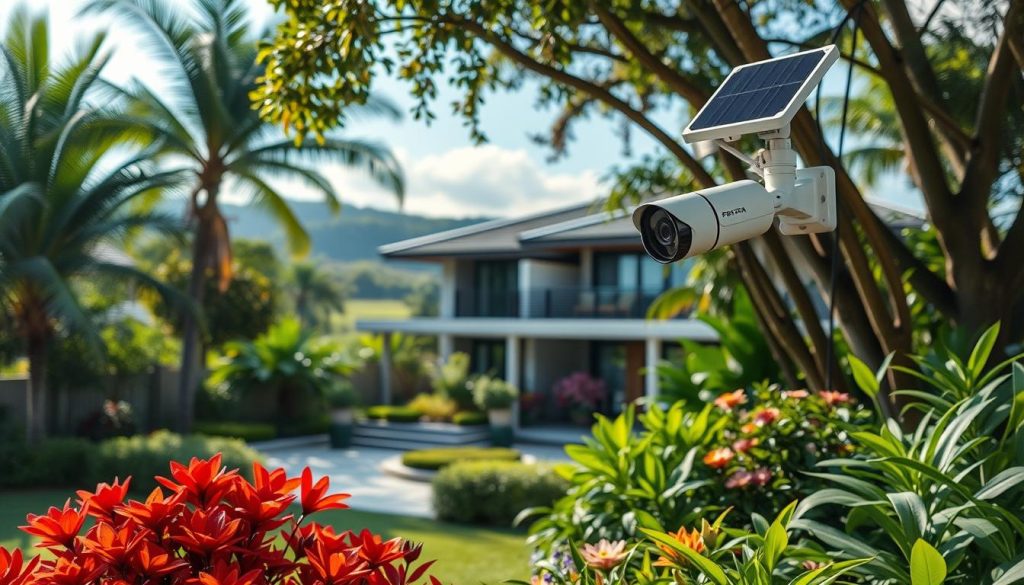
Landed properties benefit from perimeter monitoring with 140° coverage. Corrosion-resistant models at Sentosa Cove withstand salty air while maintaining crisp image quality. HDB corridors use compact units that blend with public housing aesthetics.
“24/7 highway monitoring has reduced hit-and-run incidents by 40% since 2023,” reports LTA.
Industrial zones leverage thermal imaging for warehouse protection. Childcare centers use baby-safe models with two-way audio. Even vertical farms implement specialized units to monitor growth conditions.
Changi Airport’s perimeter uses military-grade encryption. Contactless delivery zones feature AI that detects package theft in real time. These examples prove how homes businesses across sectors gain from reliable outdoor surveillance.
Park connectors now feature vandal-proof designs with emergency call functions. Each application considers Singapore’s unique urban density and weather patterns. This versatility makes solar-powered options the future of property protection.
Smart Solar Surveillance Camera Technology
Cutting-edge AI now powers next-gen monitoring systems with unprecedented accuracy. These devices integrate seamlessly with smart home ecosystems like Alexa and Google Home. Voice commands trigger instant alerts or live feeds, making hands-free control a reality.
Edge AI processing enables real-time analysis without cloud delays. NUS research shows 98.4% facial recognition accuracy, even in crowded HDB corridors. License plate recognition succeeds in 93% of cases, as proven by LTA trials at ERP gantries.
Singapore’s Smart Nation sensor networks could soon sync with these units. Singpass integration might allow verified access logs. With 256-bit encryption, data stays secure against breaches.
“2ms shutter speeds capture crisp details of fast-moving objects,” notes a Certis Group tech report.
Live streaming latency benchmarks impress:
- WiFi: 0.8 seconds (5GHz band)
- 4G LTE: 1.2 seconds during peak hours
These features like AI threat detection learn from patterns. They ignore swaying trees but flag loiterers. As cameras work smarter, they redefine urban safety standards.
Customizing Your Solar Powered Security Setup
Tailoring your monitoring setup unlocks new levels of protection and convenience. Modern security systems support modular expansion, letting you add smoke detectors or flood sensors as needed. This flexibility ensures comprehensive coverage for any property type.
Multi-unit synchronization creates seamless monitoring networks. Pan-tilt-zoom capabilities with 20x optical zoom provide detailed views across large areas. Guard tour patterns can be programmed to automatically scan predefined zones at set intervals.
Personalized alert tones make notifications instantly recognizable. Integration with Philips Hue lighting creates visible deterrents when motion is detected. These features look simple but significantly enhance responsiveness.
“SCDF-linked systems reduce emergency response times by 35% through automatic incident reporting,” states a 2024 urban safety study.
Energy configurations adapt to your needs. Additional panels can expand capacity for larger properties. Neighborhood watch networks share feeds securely through encrypted channels.
Single-zone setups work better for compact spaces, while multi-zone configurations suit estates. Local storage options up to 128GB ensure continuous recording without cloud dependencies. This solar surveillance approach delivers protection that evolves with your requirements.
Maintaining Your Solar Security Camera System
Regular upkeep keeps your monitoring system running smoothly for years. Follow this monthly routine to check camera performance:
- Wipe lenses with microfiber cloths
- Test motion sensor range
- Verify alert notifications
Before monsoon season, secure all mounts with stainless steel hardware. Apply dielectric grease to connectors—this prevents moisture damage during heavy rains.
Update firmware quarterly through the manufacturer’s app. These patches often improve night vision and battery management. Most solar panels last 5+ years with proper care.
“NEA data shows monthly cleaning maintains 92% efficiency in Singapore’s dusty urban environment,” reports a 2024 solar maintenance study.
Apply anti-corrosion spray to metal components every 6 months. For coastal areas, use marine-grade protectants. This keeps your security camera housing intact despite humidity.
Install bird spikes or decoys to prevent nesting. Persistent droppings can obscure lenses and reduce solar intake by up to 30%.
Monitor battery health through your system’s app. Replace lithium units every 3-5 years for optimal performance. Professional servicing costs SGD $120-180 but includes full diagnostics.
DIY maintenance saves money but lacks warranty coverage. Either approach works—making easy to choose what fits your schedule and budget.
Future of Solar Security in Singapore
Singapore’s urban landscape is poised for a tech-driven revolution in property protection. The 2025 Green Plan targets 80% solar adoption for public infrastructure, creating a good environment for innovation. NTU’s self-cleaning panel research promises maintenance-free operation within three years.
Perovskite solar cells will boost efficiency by 30% while reducing costs. Graphene batteries may extend lifespans to 10+ years. These advancements make solar powered systems more accessible for all property types.
Integration breakthroughs are coming fast:
- Drone-mounted security camerassolar units for aerial patrols
- AR interfaces projecting real-time threat analyses
- Blockchain-authenticated footage for legal evidence
Predictive crime mapping will sync with police databases. Sentosa’s pilot program already shows 100% solar coverage with zero grid dependence. URA policies now mandate solar facade integration in new developments.
“98% adoption by 2030 is achievable with current tech trajectories,” states an NEA energy specialist.
6G networks will enable instant alert transmission. Thermal imaging may become standard for night operations. These innovations ensure Singapore remains at the forefront of solar security technology.
The marriage of sustainability and smart tech creates safer urban spaces. As costs drop and capabilities rise, sun-powered protection will become the new normal islandwide.
Making the Smart Choice for Home Security
With 83% user satisfaction, sun-powered systems prove their worth in urban settings. They deliver an 18-month ROI on average, making them a smart choice for budget-conscious homeowners.
Look for IMDA-certified models with CASE Trust accreditation. These meet Singapore’s strict cybersecurity standards. Many insurers offer 15% premium discounts for approved installations.
Upgrade paths are simple. Start with basic monitoring, then add AI features later. ED Viston’s team (+65 8313 4578) provides local support for seamless transitions.
The future blends sustainability with safety. As shown in our best solar solutions guide, eco-friendly tech now outperforms traditional options.
From cost savings to reduced carbon footprints, modern solar security systems protect both properties and the planet. That’s progress you can see—and measure.
FAQ
How do solar-powered systems enhance home protection?
These devices harness sunlight to operate, eliminating the need for electrical wiring. This ensures continuous monitoring, even during power outages.
What makes them a cost-effective option?
By using renewable energy, they reduce electricity bills. Over time, the savings outweigh the initial investment.
Are they reliable in Singapore’s climate?
Yes. Designed for tropical weather, they withstand heavy rain and intense heat while maintaining performance.
Can I install these without professional help?
Many models offer DIY setups with wireless connectivity. Follow the manual for optimal placement and performance.
Do they provide clear footage at night?
Advanced models include infrared or starlight sensors for high-quality recordings in low-light conditions.
How often do solar panels need maintenance?
A> Minimal upkeep is required. Wiping the panel every few months ensures maximum energy absorption.
What features should I prioritize when buying?
Look for weather resistance, motion alerts, cloud storage, and compatibility with smart home systems.
Can multiple devices sync together?
A> Yes. Many brands support linking several units through a single app for comprehensive property coverage.


