
How Much Electricity Does CCTV Use Per Month? Explained
Security monitoring systems have become essential for both homes and businesses in Singapore. Many people wonder about the energy requirements of these surveillance solutions.
CCTV systems typically consume minimal power compared to other household appliances. This makes them cost-effective for continuous operation.
Different camera types have varying energy needs. Analog models generally use 4-8 watts per hour, while IP cameras range between 5-10 watts.
Specific models like the Reolink RLC-810A demonstrate impressive efficiency. This PoE IP camera consumes less than 12W during operation.
Understanding these consumption patterns helps in planning long-term security investments. Energy efficiency becomes particularly important in Singapore’s context.
Key Takeaways
- CCTV systems have relatively low power requirements compared to other electronics
- Analog cameras typically consume 4-8 watts per hour during operation
- IP cameras generally use 5-10 watts per hour for surveillance functions
- Modern models like the Reolink RLC-810A maintain consumption under 12W
- Understanding power usage helps estimate long-term operational costs
- Energy efficiency is particularly valuable in Singapore’s utility context
- Proper power planning ensures sustainable security system operation
Understanding CCTV Power Consumption and Your Electricity Bill
Many property owners wonder about the financial impact of running security cameras. The connection between camera operation and monthly expenses is straightforward. Each device draws power, and this usage accumulates on your utility statement.
A typical surveillance camera consumes approximately 0.1152 kWh daily. This translates to about 3.5 kWh monthly for a single unit. Over a full year, that’s roughly 41.5 kWh per camera.
Recording equipment significantly affects total energy needs. DVR and NVR systems typically require 40-60 watts during operation. This additional load must be included in your overall calculation.
Multiple cameras create a cumulative effect on power draw. Four cameras with a recorder can use substantially more energy than a single standalone unit. This multiplier effect is crucial for accurate cost forecasting.
Modern security technology offers impressive efficiency. Despite continuous operation, most systems contribute minimally to household energy bills. Proper planning ensures these costs remain manageable long-term.
Comparing camera consumption to common appliances provides valuable perspective. Most surveillance systems use less power than standard incandescent bulbs. This efficiency makes them practical for extended security monitoring.
Understanding both camera and recorder requirements forms the foundation for smart security decisions. Subsequent sections will explore detailed calculations and optimization strategies for Singaporean homeowners and businesses.
Breaking Down the Basics: How CCTV Systems Use Power
Understanding the electrical fundamentals of surveillance systems helps optimize their operational efficiency. These principles form the foundation for calculating energy requirements and managing long-term costs.
Voltage and Current: The Foundation of Power Draw
Most security cameras operate on a 12-volt direct current (DC) standard. This consistent voltage makes comparing different surveillance systems straightforward.
Current draw varies based on camera features and operational modes. Infrared night vision and pan-tilt-zoom functions typically increase current requirements. Understanding these variations helps select appropriate power supplies.
Voltage requirements directly affect power supply selection. Proper matching ensures stable operation and prevents equipment damage. This is crucial for reliable security monitoring.
From Watts to Kilowatt-Hours: Measuring Energy Use
Wattage serves as the primary measurement for power consumption in security systems. It represents the actual energy used during operation.
The Axis M4215-LV dome camera demonstrates typical consumption patterns. It uses approximately 4.8 watts during normal operation. This can increase to 9.5 watts with activated features.
Converting watts to kilowatt-hours enables practical energy measurement. This conversion forms the basis for calculating operational costs. It’s essential for accurate budget planning.
Daily consumption equals wattage multiplied by operational hours. Monthly figures involve multiplying daily use by thirty. Annual calculations extend this further for long-term planning.
Continuous operation significantly impacts total energy usage. Systems running 24/7 accumulate substantial consumption over time. This makes efficiency particularly valuable for always-on surveillance.
Different CCTV Camera Types and Their Power Demands
The power consumption landscape varies significantly across different CCTV camera technologies available today. Each camera type brings unique energy requirements that affect your overall system efficiency.
Surveillance systems offer multiple options with distinct electrical characteristics. Understanding these differences helps optimize both security coverage and energy usage.
Analog vs. IP Cameras: A Power Consumption Comparison
Traditional analog cameras represent the more basic surveillance technology. These devices typically consume between 4-8 watts during operation.
Modern IP cameras offer enhanced digital capabilities but require slightly more energy. Network-connected models generally use 5-10 watts for their advanced functions.
The choice between these technologies involves balancing feature sets against power requirements. IP cameras provide superior resolution and connectivity at a modest energy increase.
The Impact of Infrared and Night Vision Features
Additional functionality significantly affects camera energy draw. Infrared illumination and night vision capabilities add 2-4 watts to baseline consumption.
These features enable 24/7 monitoring but increase power usage substantially. The energy impact remains consistent across both analog and IP platforms.
Night vision functionality proves essential for comprehensive security coverage. The additional wattage represents a worthwhile investment for complete protection.
PTZ Cameras: Understanding Their Higher Energy Needs
Pan-tilt-zoom cameras represent the most feature-rich surveillance option. These advanced units consume 12-15 watts during operation.
Mechanical components and advanced processing drive their increased power requirements. Motorized movement and digital zoom capabilities demand additional energy.
PTZ models offer unparalleled monitoring flexibility at a higher operational cost. Their powerful functionality justifies the increased consumption for critical security applications.
Camera resolution and advanced features directly correlate with increased power demands. Higher megapixel sensors and processing-intensive analytics require more electrical support.
Selecting camera types involves balancing security needs against energy considerations. Basic models provide efficient monitoring while feature-rich options deliver enhanced capabilities.
For comprehensive guidance on optimizing your security system’s efficiency, explore our detailed analysis of CCTV power consumption strategies.
Beyond the Camera: Power Usage of DVR and NVR Systems
Recording devices form the operational core of modern surveillance networks. These components handle video processing, storage, and management functions.
Their energy requirements often exceed those of individual security cameras. This makes them crucial for total system power planning.
How Recorders Add to Your Total Energy Load
Digital video recorders and network video recorders consume substantial energy. Most units require 40-60 watts during active operation.
Specific models demonstrate varying consumption patterns. Hikvision DVR systems typically use around 40 watts.
Dahua recorders can reach up to 60 watts during peak processing. This variation depends on internal components and workload.
Multiple factors influence recorder energy needs:
- Number of connected channels and cameras
- Processing power required for video analytics
- Storage drive quantity and type
- Resolution and frame rate settings
These systems often draw more power than the cameras they support. This makes them significant contributors to overall electricity usage.
Comparing Standby Mode vs. Active Recording Power Draw
Modern recorders feature different operational states with varying energy demands. Standby mode significantly reduces power consumption.
Units in standby typically use only 2-4 watts. This represents substantial savings during inactive periods.
Active recording requires full system engagement. Processing live footage demands maximum resource allocation.
The difference between modes highlights optimization opportunities. Strategic scheduling can reduce operational costs substantially.
Continuous 24/7 operation creates cumulative energy impact. This affects long-term electricity bills for Singaporean properties.
Calculating total system power requires adding recorder and camera consumption. This provides accurate operational cost forecasting.
Energy-efficient configurations balance performance with power needs. Proper setup ensures effective surveillance without excessive energy use.
Key Factors That Influence Your CCTV Electricity Usage
Multiple elements determine the energy requirements of surveillance systems. These variables work together to create your total power consumption profile.
Understanding these factors helps optimize both security coverage and operational costs. Smart configuration choices can significantly reduce energy usage.
Camera Resolution and Frame Rate Settings
Higher resolution settings demand more processing power from surveillance equipment. A 4K camera typically consumes 30-50% more energy than a 1080p model.
Frame rate adjustments also affect power usage. Higher frame rates require more processing and storage resources.
Balancing resolution and frame rate creates optimal efficiency. Most security situations don’t require maximum settings.
Total Number of Cameras and Operational Hours
Each additional camera increases your system’s total energy draw. The relationship is essentially linear but cumulative.
Operational duration significantly impacts consumption. Continuous 24/7 monitoring uses substantially more power than motion-activated recording.
Modern systems offer smart scheduling features. These can reduce operational hours during low-risk periods.
Environmental Factors and System Age
Temperature extremes affect camera efficiency. Both very hot and very cold conditions can increase power consumption.
Older surveillance technology generally uses more energy. Modern components feature improved power management capabilities.
Regular maintenance ensures optimal performance. Clean lenses and proper ventilation help maintain efficiency.
Multiple factors combine to determine your final energy usage. Resolution settings, camera count, and operational patterns all contribute.
Environmental conditions and equipment age also play important roles. Understanding these elements helps create efficient security solutions.
Smart configuration choices can reduce power consumption significantly. This maintains security coverage while minimizing operational costs.
How Much Electricity Does CCTV Use Per Month? The Calculation
Accurate energy calculation forms the foundation of smart security system management. Understanding your surveillance setup’s power requirements helps predict operational expenses effectively.
Proper calculation methods provide clarity on long-term costs. This knowledge empowers informed decisions about security investments.
Step-by-Step Guide to Calculating Your System’s Wattage
Begin by identifying each component’s power specifications. Check manufacturer labels or documentation for wattage ratings.
Most security cameras display their power requirements clearly. Recording equipment typically shows consumption data on specification sheets.
Create a comprehensive list of all surveillance components. Include every camera, recorder, and additional processing unit.
Sum the wattage values for accurate total system demand. This gives you the baseline power requirement during active operation.
Consider different operational modes when calculating totals. Night vision and infrared features increase consumption during darkness hours.
Motion-activated systems have variable power needs. Their consumption depends on activity levels in monitored areas.
Converting Watt-Hours to Monthly Kilowatt-Hours (kWh)
The conversion formula provides practical energy measurement. Use this equation: (Total wattage × Operational hours) ÷ 1000.
This calculation transforms raw power data into usable consumption figures. It forms the basis for understanding electricity bills.
Most surveillance cameras consume approximately 0.1152 kWh daily. This represents typical energy usage for continuous operation.
Extrapolate daily figures to monthly totals by multiplying by thirty. Annual calculations involve further multiplication by twelve.
Recording equipment significantly impacts total energy consumption. DVR and NVR systems require additional power beyond camera needs.
Always include recorder consumption in your final calculations. This ensures accurate prediction of total system requirements.
Real-world examples demonstrate practical application. A four-camera system with recorder might use 1.2 kWh daily.
This translates to approximately 36 kWh monthly. These figures help budget for operational costs effectively.
Verification of manufacturer specifications ensures calculation accuracy. Some devices may consume more power than stated ratings.
Actual measurements provide the most reliable consumption data. Use power meters for precise monitoring when possible.
“Proper power calculation isn’t just about numbers—it’s about understanding your security system’s true operational cost and efficiency.”
Accurate energy forecasting supports sustainable security management. It enables smart decisions about system configuration and usage patterns.
These calculations prove particularly valuable in Singapore’s context. They help manage electricity bills while maintaining comprehensive protection.
Translating kWh into Cost: Calculating Your Monthly Bill in Singapore
Calculating operational expenses for surveillance equipment requires understanding local utility rates and consumption patterns. Singapore’s unique energy market structure directly affects your security system’s running costs.
Knowing how to convert technical power measurements into practical dollar amounts helps budget effectively. This knowledge proves valuable for both residential and commercial installations.
Understanding Singapore’s Electricity Tariffs
Singapore’s electricity market features a regulated tariff system that changes quarterly. These adjustments reflect fuel costs and market conditions that affect all consumers.
Current rates typically range between S$0.29 to S$0.32 per kWh for residential customers. Commercial properties often negotiate different rates based on consumption volume.
The tariff structure includes several components:
- Energy costs based on actual consumption
- Network charges for infrastructure maintenance
- Market administration fees
- GST charges applied to the total bill
These elements combine to create your final electricity rate. Understanding each component helps analyze your surveillance system’s impact.
A Real-World Cost Estimation Example
Consider a typical four-camera security setup with recording equipment. This configuration might consume approximately 1.2 kWh daily during continuous operation.
Monthly consumption would total around 36 kWh. At current Singapore rates of S$0.30 per kWh, the monthly cost would be approximately S$10.80.
Different configurations significantly affect final expenses. A single camera system might cost only S$2-3 monthly, while extensive commercial installations could reach S$50-60.
Motion-activated systems reduce operational hours substantially. They might only use 20-30% of continuous operation energy, lowering costs accordingly.
Seasonal rate variations impact long-term budgeting. Tariff changes of 5-10% quarterly can alter annual expenses noticeably.
Tracking actual consumption against estimates ensures accurate forecasting. Smart meters and energy monitoring devices provide precise data for comparison.
“The true cost of security monitoring extends beyond equipment purchase—understanding operational expenses ensures sustainable protection.”
Long-term cost analysis helps make informed security decisions. Energy-efficient configurations provide substantial savings over years of operation.
Businesses should consider these expenses when planning security budgets. Residential users benefit from understanding their surveillance system’s impact on household bills.
Regular review of consumption patterns identifies optimization opportunities. This proactive approach maintains security while minimizing operational costs.
Strategies for Optimizing Your CCTV System’s Power Consumption
Smart configuration choices can dramatically reduce your surveillance system’s energy demands. These optimization techniques maintain security coverage while cutting operational expenses.
Proper setup ensures effective monitoring without excessive power drain. This approach benefits both residential and commercial installations in Singapore.
Scheduling Recordings and Using Motion Activation
Strategic scheduling reduces unnecessary recording during low-risk periods. Configure your system to record only during specific hours when activity is likely.
Motion activation provides substantial energy savings versus continuous recording. These systems consume power only when detecting movement.
Optimal motion detection settings balance security and efficiency. Adjust sensitivity to avoid false triggers while capturing genuine threats.
Key configuration tips for motion activation:
- Set detection zones to focus on critical areas only
- Adjust sensitivity based on environmental conditions
- Configure pre-and post-recording buffers appropriately
- Test different settings during various times of day
These adjustments can reduce energy consumption by 70-80% compared to 24/7 operation. The savings add up significantly over time.
Adjusting Resolution and Frame Rates for Efficiency
Resolution settings directly impact power requirements. Higher resolutions demand more processing power and energy.
Reducing from Full HD to standard HD can cut bandwidth needs by 60%. This also lowers storage requirements and energy consumption.
Frame rate adjustment offers another efficiency opportunity. Lowering frames per second from 25 to 8 reduces bandwidth and storage by 70%.
Recommended settings for different scenarios:
- High-security areas: 1080p at 15 FPS
- General monitoring: 720p at 8 FPS
- Low-traffic zones: 480p at 5 FPS with motion activation
These optimizations maintain adequate surveillance quality while minimizing power usage. The balance depends on your specific security needs.
Implementation steps for common systems:
- Access your camera’s web interface or mobile app
- Navigate to video settings or configuration menu
- Adjust resolution and frame rate settings gradually
- Test image quality at different reduction levels
- Save optimal settings for each camera position
Monitor energy savings through your electricity bills over several months. Compare consumption before and after implementing these changes.
“The most efficient security system isn’t the one that uses the least power—it’s the one that provides adequate protection at the lowest sustainable operating cost.”
Regular review ensures your configuration remains optimal. Adjust settings as your security needs or environmental conditions change.
These strategies help manage operational costs while maintaining reliable surveillance. They prove particularly valuable for long-term security planning in Singapore.
Choosing Energy-Efficient CCTV Components
Selecting energy-efficient surveillance components represents a strategic approach to modern security management. This process involves evaluating multiple technical specifications and understanding how different elements contribute to overall system efficiency.
Energy-conscious choices directly impact operational costs and environmental footprint. Smart selection helps create sustainable security solutions that perform effectively while minimizing power requirements.
What to Look for in Low-Power Cameras and Recorders
Modern security equipment offers varying energy profiles. Key specifications help identify components that use less power while maintaining performance standards.
Look for cameras with efficient sensor technology and optimized processing chips. These elements significantly reduce electricity consumption during operation.
Energy efficiency ratings provide valuable comparison data. Manufacturers often disclose power requirements under different operating conditions.
Advanced chipset technology represents a major advancement in power management. Modern processors deliver better performance with lower energy demands.
Specific models demonstrate exceptional efficiency characteristics. The Reolink Argus 3 Pro operates on solar power with minimal grid dependence.
The Reolink Go Plus offers similar benefits for remote locations. Both models show how innovative design reduces overall system power requirements.
The Benefits of Power over Ethernet (PoE) Technology
Power over Ethernet technology simplifies surveillance system installation and operation. This approach delivers both data and power through a single network cable.
PoE eliminates the need for separate electrical wiring. This reduction in cabling complexity also decreases potential energy loss points.
The technology ensures optimized power delivery to connected devices. Systems receive exactly the energy they need without unnecessary waste.
PoE switches and injectors come in various configurations. Selection depends on the number of cameras and their specific power requirements.
Compatibility considerations include cable length and device specifications. Proper matching ensures efficient operation and prevents performance issues.
Traditional power delivery methods show higher energy loss rates. PoE technology typically demonstrates 20-30% better efficiency in comparative analysis.
Building a comprehensive energy-efficient system involves multiple considerations. Component selection, technology integration, and proper configuration all contribute to optimal performance.
Prioritize equipment with verified low power consumption characteristics. Combine this with smart technology like PoE for maximum efficiency benefits.
Regular monitoring and adjustment maintain optimal energy usage patterns. This approach ensures long-term efficiency and cost effectiveness for Singaporean installations.
The Role of Power over Ethernet (PoE) in Modern CCTV
Modern surveillance solutions increasingly embrace Power over Ethernet technology. This approach transforms how we power and connect security devices.
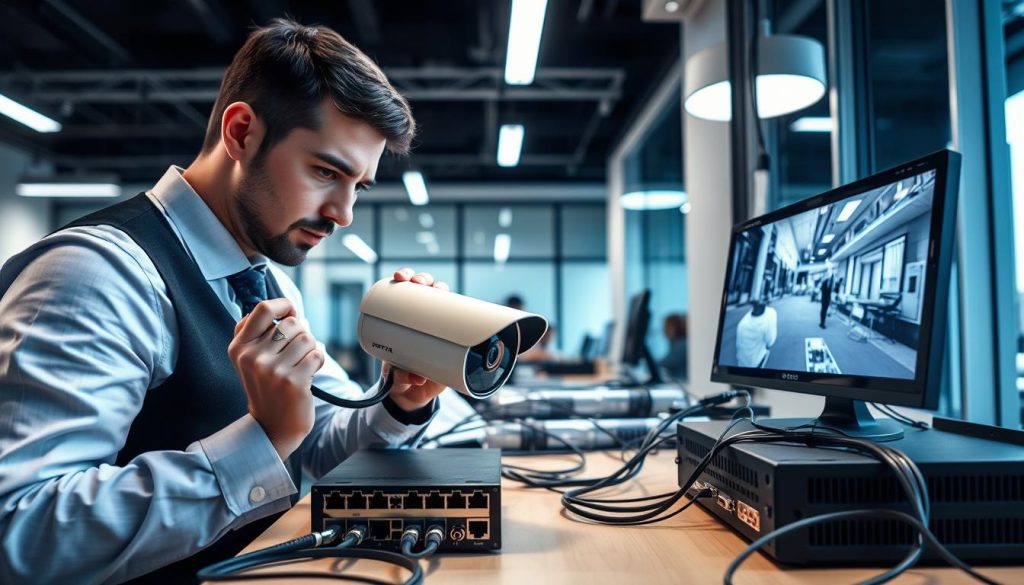
PoE delivers both electrical power and data through a single Ethernet cable. This eliminates the need for separate power supplies near each camera.
How PoE Simplifies Installation and Can Reduce Energy Loss
Installation becomes significantly easier with PoE technology. You only need to run one cable to each camera location.
This simplicity reduces labor costs and installation time. It also minimizes wall damage during setup.
Centralized power management offers efficiency benefits. PoE switches provide optimized power delivery to connected devices.
This centralized approach reduces energy loss compared to traditional methods. It ensures cameras receive exactly the power they need.
PoE technology can help systems use less power overall. The reduced cable length and optimized delivery contribute to this efficiency.
Important Considerations for a PoE CCTV Setup
Different PoE standards offer varying power capabilities. Understanding these standards ensures proper equipment selection.
Key PoE standards include:
- IEEE 802.3af (PoE): Up to 12.95W per port
- IEEE 802.3at (PoE+): Up to 25.5W per port
- IEEE 802.3bt (PoE++): Up to 71.3W for Type 4
Camera power requirements determine which standard you need. High-performance cameras with advanced features require more power.
Cable length affects performance and power delivery. Ethernet cables should not exceed 100 meters for optimal operation.
Signal integrity depends on cable quality. Use Cat5e or higher cables for reliable performance.
Selecting appropriate PoE switches requires careful planning. Consider these factors:
- Total number of cameras in your system
- Individual camera power requirements
- Future expansion possibilities
- Switch power budget capacity
Compatibility between PoE equipment and cameras is crucial. Verify that all components support the same PoE standard.
Installation best practices ensure optimal performance. Use quality cables and proper connectors throughout the system.
Proper grounding protects equipment from power surges. This is especially important in Singapore’s climate.
PoE technology supports system scalability and future growth. You can easily add more cameras as security needs evolve.
The technology’s flexibility makes it ideal for various applications. Both residential and commercial installations benefit from its advantages.
“PoE represents more than just convenience—it’s a fundamental shift toward smarter, more efficient security infrastructure that grows with your needs.”
These considerations help create reliable and efficient surveillance systems. Proper planning ensures long-term performance and cost effectiveness.
Exploring Alternative Power Sources for CCTV
Modern security solutions increasingly incorporate alternative energy options. These approaches provide reliable operation while reducing environmental impact.
Solar technology and backup systems offer practical alternatives to traditional grid power. They ensure continuous surveillance during outages or in remote locations.
Solar-Powered CCTV Solutions for Sustainable Security
Solar-powered surveillance systems harness renewable energy for operation. They convert sunlight into electrical power through photovoltaic panels.
These systems store energy in batteries for nighttime operation. This ensures 24/7 monitoring capability without grid dependence.
Key components of solar security setups include:
- Photovoltaic panels for energy capture
- Charge controllers for battery management
- Deep-cycle batteries for energy storage
- Power inverters for DC to AC conversion
Solar options prove ideal for remote installations. They eliminate the need for extensive electrical infrastructure.
Areas with unreliable grid power benefit significantly from solar solutions. These systems maintain security during frequent power interruptions.
The Reolink Argus 3 Pro demonstrates solar capability effectively. This wireless camera operates continuously using solar panel charging.
Initial investment in solar technology may seem substantial. However, long-term savings offset these costs through reduced electricity bills.
Solar systems eliminate ongoing power expenses completely. This makes them economically attractive over extended periods.
Proper sizing ensures optimal solar system performance. Consider these factors when planning:
- Daily sunlight hours at your location
- Camera power requirements and operational hours
- Battery capacity for nighttime operation
- Seasonal weather variations affecting solar gain
Maintenance involves regular panel cleaning and battery checks. These simple steps ensure consistent system performance.
Using UPS Systems for Backup Power and Protection
Uninterruptible Power Supply units provide crucial backup during outages. They instantly switch to battery power when grid electricity fails.
UPS systems protect surveillance equipment from power fluctuations. Voltage spikes and surges can damage sensitive electronic components.
Different UPS types serve specific security needs:
- Standby UPS for basic backup protection
- Line-interactive UPS for voltage regulation
- Online UPS for maximum power conditioning
These systems maintain camera operation during brief outages. They provide time for generators to activate during extended interruptions.
Power protection benefits extend beyond simple backup functionality. UPS units filter electrical noise and stabilize voltage levels.
This protection extends equipment lifespan significantly. It prevents damage from common power quality issues.
Proper UPS sizing depends on your security system’s requirements. Consider total power draw and desired backup duration.
Integration with existing power systems requires careful planning. Hybrid setups combining solar, grid, and UPS offer maximum reliability.
Regular testing ensures UPS readiness during actual outages. Battery replacement every 3-5 years maintains optimal performance.
“A well-designed backup power system doesn’t just prevent downtime—it protects your security investment from electrical damage that could compromise entire surveillance networks.”
These alternative power solutions enhance overall system reliability. They ensure continuous security monitoring under various conditions.
Smart power management reduces operational costs in the long run. It also minimizes environmental impact through efficient energy usage.
Long-Term Financial Benefits of an Efficient CCTV System
Smart security investments deliver substantial financial returns beyond basic protection. Efficient surveillance technology creates lasting value through multiple financial channels.
Total cost analysis reveals the complete financial picture. This includes both initial setup expenses and ongoing operational costs.
Weighing Initial Investment Against Ongoing Operational Costs
Quality surveillance systems require careful financial planning. The upfront investment often represents only part of the total expense.
Energy-efficient components typically cost slightly more initially. However, they deliver significant savings in the long run through reduced power consumption.
Consider these cost comparison points:
- Standard cameras vs energy-efficient models price difference
- Installation costs for different system types
- Monthly electricity bills for various configurations
- Maintenance expenses over 5-year periods
High-quality components demonstrate better durability. They require fewer replacements and repairs over time.
Efficient power management reduces operational expenses substantially. This creates compounding savings throughout the system’s lifespan.
Potential Impact on Home Insurance Premiums
Security systems can influence insurance costs significantly. Many providers offer discounts for properties with monitored surveillance.
Insurance companies recognize the risk reduction benefits. Proper security installation demonstrates responsible property management.
Typical insurance benefits include:
- 5-20% premium reductions for residential policies
- Higher discounts for commercial security systems
- Additional savings for monitored alarm integration
- Potential waiver of certain security-related deductibles
Theft prevention represents the most significant financial benefit. Effective surveillance deters criminal activity and reduces loss incidents.
Businesses experience particularly strong financial impacts. Reduced shrinkage and improved safety justify the security investment.
Documentation from security systems supports insurance claims. This can streamline the claims process and improve outcomes.
Case studies show impressive return on investment figures. One Singapore retail business reported 35% lower insurance costs after system installation.
Another residential example demonstrated full system cost recovery within 18 months. This came through combined insurance savings and prevented theft incidents.
“The most valuable security system pays for itself multiple times over—not just through prevented losses, but through ongoing operational efficiency and financial benefits that continue year after year.”
Environmental benefits add another dimension to the financial picture. Reduced energy consumption lowers carbon footprint while saving money.
Calculation guidance for return on investment:
- Document all initial equipment and installation costs
- Calculate monthly energy savings from efficient components
- Factor in insurance premium reductions
- Estimate potential loss prevention benefits
- Project maintenance savings from quality components
These calculations help make informed security decisions. They reveal the true financial impact of different system configurations.
Long-term thinking transforms security from expense to investment. The right system delivers protection and financial benefits for years.
Innovations and Future Trends in CCTV Power Management
Surveillance technology continues evolving with remarkable energy efficiency breakthroughs. These advancements address growing environmental concerns while maintaining security performance.
Modern innovations focus on reducing operational costs through smarter power management. They also minimize the environmental impact of security systems.
Energy-Efficient Chipsets and Low-Power Design
Recent processor developments have transformed camera efficiency. New chipsets deliver superior performance while using significantly less energy.
These advanced components optimize power distribution throughout the system. They activate only necessary functions based on real-time needs.
Low-power modes represent another major innovation. Cameras can now reduce energy consumption by up to 50% during inactive periods.
Smart design approaches include:
- Advanced sleep modes during low-activity hours
- Dynamic voltage scaling based on processing demands
- Efficient heat dissipation to reduce cooling needs
- Optimized circuit design minimizing energy loss
These innovations maintain full security capabilities while cutting power requirements. The right conditions can lower overall usage by 25% or more.
Manufacturers continuously refine their power management approaches. Each generation brings improved efficiency without compromising security quality.
The Growing Role of AI and Smart Analytics in Saving Energy
Artificial intelligence revolutionizes how surveillance systems manage power. Smart algorithms analyze patterns to optimize energy usage throughout the day.
AI-powered motion detection significantly reduces unnecessary recording. Systems now distinguish between relevant events and false triggers more accurately.
Predictive analytics anticipate security needs based on historical data. This allows systems to adjust power levels before events occur.
Key AI benefits include:
- Intelligent scheduling based on activity patterns
- Advanced object recognition reducing false alarms
- Automated resolution adjustment for different scenarios
- Predictive power management anticipating security needs
These technologies ensure cameras operate at optimal efficiency levels. They maintain security while minimizing electricity consumption.
Emerging technologies promise even greater efficiency gains. Wireless power transmission and energy harvesting represent the next frontier.
Solar integration continues advancing with more compact and efficient panels. These systems provide reliable operation while reducing grid dependence.
Carbon footprint considerations increasingly influence security system design. Many organizations now prioritize environmental impact alongside security needs.
Future systems may feature:
- Ultra-low-power sensors for continuous monitoring
- Advanced energy harvesting from environmental sources
- Predictive maintenance reducing energy waste
- Integrated renewable energy solutions
These developments will shape next-generation surveillance technology. They’ll deliver enhanced security with minimal environmental impact.
“The future of security monitoring lies in systems that protect both people and the planet—where advanced technology meets environmental responsibility through intelligent power management.”
Singaporean property owners can benefit from these innovations. Modern systems offer superior protection while aligning with sustainability goals.
For those interested in renewable security solutions, explore our guide to solar-powered CCTV options that combine modern technology with environmental consciousness.
Maintenance Tips to Ensure Peak Efficiency and Lower Costs
Proper maintenance extends your security investment’s lifespan while reducing operational expenses. Regular care prevents unexpected failures and maintains optimal performance.
Well-maintained equipment operates more efficiently over time. This directly impacts your electricity bills and overall system reliability.
Routine Checks for Optimal Power Supply Performance
Regular inspections keep your security system running smoothly. They identify potential issues before they affect your cameras.
Check power supplies monthly for proper voltage output. Most security cameras require stable 12V DC power.
Use a multimeter to verify voltage consistency. Fluctuations above 10% indicate potential problems.
Monitor current draw during different operational modes. Night vision and infrared features increase power demands.
Create a comprehensive maintenance schedule:
- Weekly visual inspections of all connections
- Monthly voltage and current measurements
- Quarterly cleaning of power components
- Annual professional system assessment
Clean power supplies regularly to prevent overheating. Dust accumulation reduces efficiency and increases consumption.
Check for warning signs like unusual noises or heat. These indicate impending component failure.
Replace aging power adapters before they fail. Old units often consume more energy while delivering less power.
The Importance of Quality Cabling and Connections
Superior cabling significantly reduces power loss throughout your system. Proper installation maintains voltage integrity over distance.
Use appropriate cable gauges for your camera’s power requirements. Thinner wires cause voltage drop over longer runs.
Quality connectors ensure reliable power delivery. Loose connections increase resistance and energy waste.
Inspect cables regularly for damage or corrosion. Environmental factors can degrade insulation over time.
Proper cable management prevents accidental damage. Organized routing simplifies future maintenance.
Consider these cable quality indicators:
- Copper purity and conductor thickness
- Insulation material and thickness
- UV resistance for outdoor applications
- Waterproof ratings for exposed locations
Test cable resistance periodically using a multimeter. Increased resistance signals aging or damage.
Replace cables showing significant resistance changes. This maintains efficient power delivery to your cameras.
Proper grounding protects against power surges. This is particularly important in Singapore’s climate.
“The difference between adequate and exceptional security often comes down to maintenance—those extra minutes spent checking connections today prevent hours of downtime tomorrow.”
Document all maintenance activities for future reference. This helps identify patterns and predict component lifespan.
Keep spare parts for critical components on hand. Quick replacement minimizes system downtime during failures.
Regular maintenance ensures your security system operates at peak efficiency. This reduces long-term operational costs while maintaining reliable protection.
Making an Informed Decision on Your Security and Energy Use
Choosing the right surveillance setup involves balancing protection needs with operational efficiency. Modern security systems offer impressive energy savings when configured properly.
Most cameras consume minimal power, especially efficient models like the Reolink RLC-810A. Advanced features may increase consumption slightly but enhance monitoring capabilities.
Consider both upfront and long-term costs when selecting equipment. Energy-efficient choices reduce monthly bills and environmental impact over time.
Evaluate your specific security requirements against power needs. Smart configurations maintain protection while optimizing electricity usage.
Analyze consumption data before implementation for best results. This approach ensures cost-effective, reliable surveillance for any property.
FAQ
Do CCTV cameras use a lot of electricity?
Most modern security cameras are designed for efficiency. A typical IP camera uses between 4 to 15 watts. A full system with a recorder and several cameras generally adds a modest amount to your monthly bill.
What factors affect my CCTV system’s power consumption the most?
The total number of cameras, their type (PTZ models use more), the use of features like infrared night vision, and whether your DVR or NVR is actively recording or in standby mode are the primary factors influencing energy use.
How can I calculate the monthly cost of running my security system?
Find the wattage of each component (camera and recorder). Multiply each by the hours used per day, sum them, then convert to kilowatt-hours (kWh). Multiply the total kWh by your local electricity rate to find the cost.
Are wired or wireless CCTV cameras more energy-efficient?
Wired cameras, especially those using Power over Ethernet (PoE), are often more efficient. They receive power and data through one cable, reducing energy loss. Wireless cameras require battery changes or constant charging, which can be less efficient long-term.
Can using motion detection instead of 24/7 recording save power?
Yes, significantly. Scheduling recordings or activating them only upon motion detection reduces the workload of both the cameras and the recorder, leading to notable energy savings over continuous operation.
What is Power over Ethernet (PoE), and how does it help?
PoE technology allows a single network cable to provide both data connection and electrical power to a device. It simplifies installation, reduces cable clutter, and can be more energy-efficient than using separate power adapters for each camera.
Do higher-resolution cameras like 4K use more electricity?
Yes. Processing and transmitting higher-resolution video requires more processing power from the camera and the recorder, which increases their power draw compared to standard HD models.
Are there solar-powered options for CCTV systems?
A> Absolutely. Solar-powered security solutions are a great option for remote locations or for those seeking to minimize grid dependency and reduce their carbon footprint. They often use a solar panel, battery, and charge controller.


