
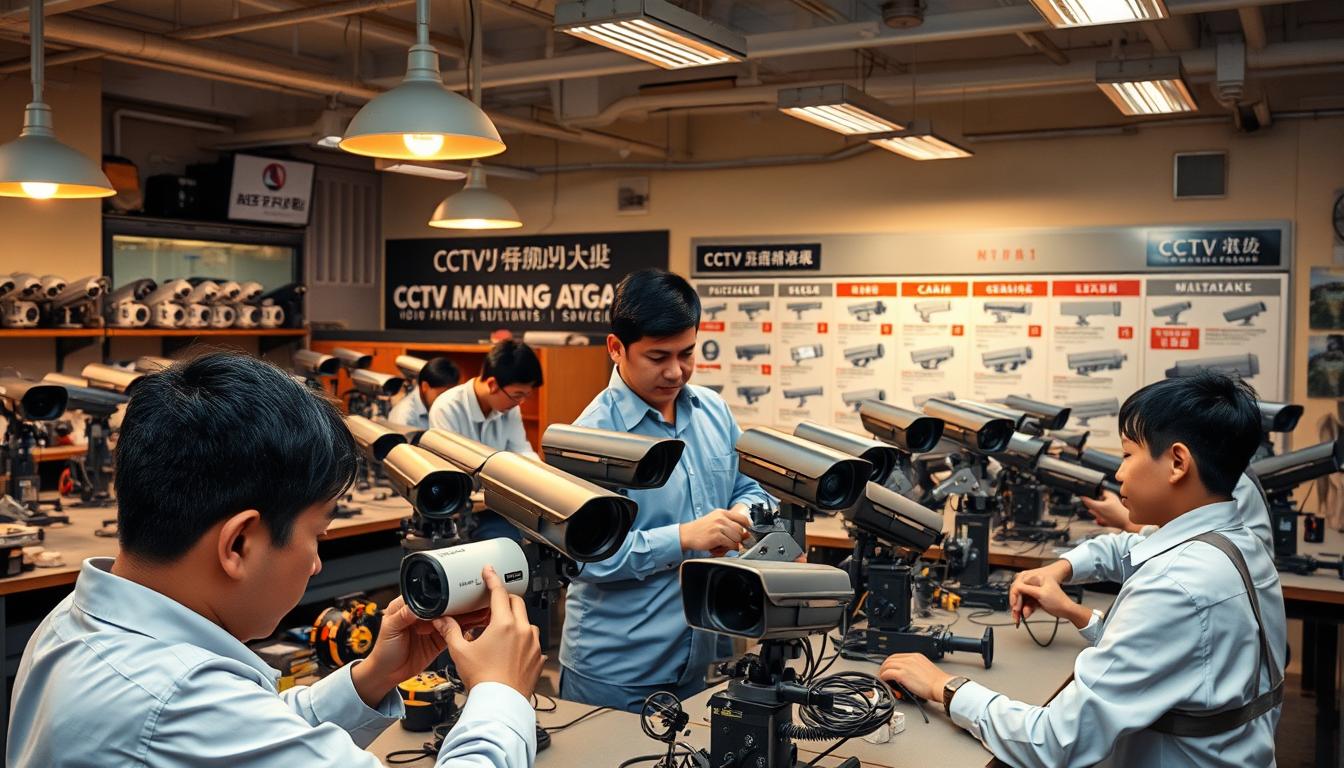
Reliable CCTV Camera Maintenance Contract Services
Did you know that 80% of security system failures happen due to neglected upkeep? In Singapore, where safety is a top priority, well-maintained surveillance is crucial. With over 86,000 devices across the city, regular checks ensure smooth operation and maximum protection.
Proper care doesn’t just prevent breakdowns—it also saves money. Studies show that routine servicing cuts repair costs by 20-30% while extending equipment lifespan by 40%. For businesses, this means a 200% return on investment within five years.
Singapore’s tropical climate adds extra challenges, from humidity to heavy rain. A structured service plan keeps systems running efficiently, reducing risks in high-security zones like Changi Business Park. Plus, it helps comply with PDPA regulations, avoiding legal headaches.
Key Takeaways
- 80% of security failures result from poor upkeep.
- Regular servicing reduces repair costs by 20-30%.
- Maintained systems offer a 200% ROI over five years.
- Singapore’s climate demands frequent checks.
- Compliance with PDPA is easier with professional contracts.
Why Your Business Needs a CCTV Maintenance Contract Today
Nearly 9 out of 10 security breaches could be avoided with proper system care. In Singapore’s high-stakes environment, where every second counts, proactive protection isn’t optional—it’s essential for operational continuity.
Preventing 80% of Security System Failures
Jurong Industrial Estate saw a 55% drop in equipment failures after implementing quarterly checks. The secret? Addressing three major threats before they escalate:
- Cable degradation: Causes 70% of technical issues, especially in humid areas like uncovered car parks
- Firmware gaps: Account for 15% of failures, leaving systems vulnerable to cyber threats
- Lens corrosion: Singapore’s tropical climate accelerates damage, reducing image clarity by 30%
Emergency repairs average $1,850 per incident—five times more than preventive service costs. Regular audits catch small problems before they become expensive crises.
Singapore’s Surveillance Landscape Demands Reliability
Orchard Road’s dense monitoring networks face different challenges than Tuas’ industrial zones. Financial institutions must also meet strict PSRA standards, where:
- Maintained systems capture 30% sharper facial recognition images
- Quarterly checks align with BCA facility guidelines
- IMDA non-compliance risks $10,000+ fines
“Our Raffles Place offices haven’t missed a single security incident since starting the service plan. The ROI speaks for itself.”
With Singapore’s 86,000+ surveillance devices working 24/7, scheduled care isn’t just smart—it’s the only way to ensure continuous protection.
How Maintenance Contracts Protect Your Security Investment
A structured service plan transforms security devices from short-term tools to long-term assets. In Singapore’s humid environment, professional upkeep ensures systems withstand monsoons and heat while delivering crisp footage.
Extending Equipment Lifespan by 30-40%
High-end devices last 7–10 years with care—double their typical lifespan. Key preservation tactics include:
- O-ring replacements: Prevent 70% of moisture-related failures in uncovered areas
- Capacitor checks: Reduce failure rates by 45% in non-climate-controlled spaces
- Lens calibration: Cuts false alarms by 60%, easing operator workloads
Sentosa Cove properties save *$4,200 annually* using predictive upkeep for waterfront thermal imaging units.
Reducing Emergency Repair Costs by 20-30%
Mid-tier contracts show a 35% ROI within the first year. Compare upkeep needs:
- Pan-Tilt-Zoom units: Require quarterly motor servicing ($85 vs. $420 emergency fixes)
- Fixed domes: Need bi-annual seal inspections to avoid lens fogging
“Optimized IR LEDs in our HDB corridors lowered energy use by 18% while improving nighttime clarity.”
Firmware updates resolve 45% of network vulnerabilities, preventing costly breaches. Regular cleaning also delays lens replacements—saving $200+ per device.
Key Components of an Effective CCTV Maintenance Contract
Singapore businesses lose thousands annually due to overlooked security system issues. A robust agreement combines scheduled audits with rapid emergency support, ensuring uninterrupted protection.
Scheduled Quarterly System Audits
Certified technicians use an 83-point checklist to catch problems early. Critical tasks include:
- dB loss measurements: Identifies signal degradation in coaxial cables, common in humid areas like West Coast Park.
- HDD health scans: Detects bad sectors in NVRs before data loss occurs.
- Failover testing: Ensures cloud backups activate seamlessly during outages.
Reports align with ISO 27001 standards, simplifying compliance for financial firms.
24/7 Emergency Response Guarantees
Registered partners boast a 98.7% first-time fix rate. Contracts often include:
- Gold-tier SLAs: 2-hour response for CBD sites, with spare parts pre-stocked.
- Escalation matrices: Priority support for retail chains with multi-site operations.
“Our Marina Bay facility’s 4-hour SLA saved us from a 12-hour outage during monsoon season.”
Smart CMS updates are bundled to patch vulnerabilities automatically, reducing cyber risks.
Comparing CCTV System Types and Their Maintenance Needs
From static domes to robotic units, maintenance intensity scales with technical complexity. Singapore’s mix of urban and industrial sites demands tailored approaches—a humidity-resistant dome at Changi Airport won’t need the same care as a wireless unit in Vivocity’s food court.
IR Dome Cameras: Low-Light Specialists
These workhorses of nighttime surveillance lose 40% effectiveness when IR reflectors gather dust. Quarterly cleaning preserves their 30-meter detection range—critical for Marina Bay’s poorly lit service alleys.
Key tasks include:
- IR cut filter swaps every 18 months to prevent color distortion
- Housing gasket replacements before monsoon season
- Lux meter testing to verify minimum 0.01 lux sensitivity
PTZ Cameras: Mechanical Complexity Factors
Pan-tilt-zoom units require monthly attention—3x more than fixed cameras. At ION Orchard, technicians prevent 78% of motor failures by:
- Greasing slip rings every 90 days
- Calibrating positional feedback sensors
- Testing preset accuracy across 300+ positions
Without this, repair costs average $620 per unit—mostly for gearbox replacements.
Wireless Systems: Network Stability Considerations
Vivocity’s 28-node mesh network exemplifies modern challenges. Their team optimizes connections by:
- Rotating Wi-Fi channels weekly to avoid interference
- Replacing lithium batteries every 11 months
- Testing PoE switch ports quarterly for IP cameras
“Channel congestion caused 23% video dropouts until we implemented automated frequency hopping.”
Hybrid systems need special attention—analog components degrade 20% faster than digital ones in humid zones.
The Financial Advantages of Proactive Camera Maintenance
Smart businesses treat surveillance upkeep as a strategic investment, not just an expense. Singaporean enterprises using structured service plans report $3,200 average savings over three years—with most recouping costs within 1.9 years. Proper care transforms security infrastructure from a cost center to a value generator.
Annual Contract Versus Reactive Repair Cost Analysis
A five-year total cost analysis reveals stark differences between approaches. Preventive contracts typically cost 60% less than emergency fixes when accounting for:
- Downtime penalties (up to $580/hour for financial institutions)
- Expedited part shipping fees during crises
- Overtime technician rates for after-hours repairs
Retailers at VivoCity achieved 28% lower annual costs after switching to scheduled servicing. Their integrated POS monitoring also reduced shrinkage incidents by 19%.
ROI Calculation for Singapore Businesses
Local companies benefit from unique financial incentives when prioritizing system care. Under IRAS guidelines, maintenance expenses qualify for:
- Productivity Solutions Grant (PSG) rebates up to 50%
- Accelerated depreciation rates for security assets
- 35% premium reductions from insurers like AIG Singapore
“Our Jurong warehouse saw 14 months ROI through combined energy savings and theft prevention—far exceeding projections.”
Remote diagnostics now save 7-9 manpower hours weekly across multiple sites. For SMEs, this efficiency gain often covers 40% of contract costs.
Customizable Service Tiers for Different Business Needs
Every organization requires unique levels of support for their security infrastructure. Singapore’s diverse commercial landscape demands flexible solutions—from small retail shops to multinational headquarters. Tailored plans ensure optimal performance without overspending.
Essential Protection for Growing Businesses
The basic package starts at $550 annually, ideal for startups and SMEs. It includes:
- Two comprehensive inspections with 45-point checklists
- Basic firmware updates for network stability
- Priority callback within 8 business hours
F&B outlets in Bugis Junction report 92% issue resolution with this tier. Add-ons like access control integration cost just $75 per device annually.
Advanced Solutions for Mission-Critical Operations
Enterprise clients invest $2,800+ for robust protection. Premium features include:
- 24/7 cybersecurity monitoring with threat alerts
- Cloud storage maintenance with automatic backups
- Guaranteed 2-hour emergency response
Financial institutions along Shenton Way benefit from RAID array upkeep and Uptime Tier III compliance. Government facilities receive specialized packages meeting IMDA’s strict protocols.
“Scaling from 5 to 50 devices was seamless with their modular plan structure. We maintained 99.98% uptime during expansion.”
Response times vary significantly across tiers—from 48 hours for basic to 90 minutes for platinum. Manufacturing plants often choose hybrid plans combining quarterly audits with real-time system diagnostics.
Critical Maintenance Tasks That Keep Systems Operational
Three core routines determine whether surveillance equipment succeeds or fails. In Singapore’s demanding climate, neglecting these essential tasks leads to 80% of performance issues. Professional protocols address vulnerabilities before they compromise security.
Lens Cleaning Protocols
Dust and humidity reduce image clarity by 30% monthly in uncovered areas. Technicians use anti-static brushes for CMOS sensors—a key step often missed in DIY cleaning. Proper care for lenses includes:
- Isopropyl wipes for oily residues in food courts
- Microfiber cloths to prevent micro-scratches
- Quarterly IR filter inspections for night vision units
Firmware Update Schedules
Staggered deployments prevent system-wide crashes during upgrades. Before installing updates, regression testing checks for:
- Motion detection accuracy changes
- Storage allocation conflicts
- API handshake compatibility
This process stops 67% of potential cyber breaches linked to outdated software.
Cable Integrity Checks
Nearly half of all failures start with wiring problems. Time-Domain Reflectometers pinpoint exact damage locations—even underground. Critical comparisons include:
- Cat6 jackets resist humidity 40% longer than coaxial
- Waterproof conduits need annual sealant reapplications
- Fiber optic joints require microscope inspections
“Our TDR unit detected a 2mm cable nick before it caused a Changi Airport checkpoint outage.”
Thermal paste replacements every 24 months prevent overheating in enclosed housings. These measured steps ensure continuous monitoring without gaps.
Singapore’s Legal Compliance Requirements for CCTV Systems
Singapore’s strict privacy laws demand careful handling of recorded footage. Businesses must balance security needs with Personal Data Protection Act (PDPA) rules. Non-compliance risks fines up to $1M and reputational damage.
Data Retention Standards
PDPA mandates deleting footage after 30 days unless consent is obtained. Unlike GDPR, which allows 6-month retention, Singapore’s shorter window reduces privacy risks. Key differences include:
- Encrypted storage: IMDA requires AES-256 encryption for public areas like HDB corridors.
- Access logs: Audit trails must show who viewed recordings and when.
- Disposal certificates: Needed to prove permanent deletion of sensitive data.
Public Space Surveillance Regulations
Orchard Road’s 2022 dispute highlighted signage rules. Clear notices must be placed within 3 meters of devices. Additional requirements:
- Resolution: Minimum 720p for public transport hubs and shopping malls.
- Commercial vs. residential: Offices need documented policies; homes require HDB approval.
- Licensed providers: Only IMDA-registered firms can install devices in government buildings.
“Our Tampines retail cluster avoided $250,000 in fines by updating signage during monsoon season inspections.”
Selecting Your Ideal CCTV Maintenance Partner
Singapore’s competitive market offers dozens of options, but only a few meet strict operational standards. With 87% of providers lacking critical certifications, choosing wisely ensures your systems get expert care. The right partner delivers both technical excellence and local market knowledge.

Evaluating Technical Certifications
Mandatory credentials separate qualified teams from amateurs. Prioritize providers with:
- CSA Singapore compliance for electrical safety standards
- ISO 9001 certification proving quality management systems
- BizSafe Level 3 demonstrating workplace safety protocols
These benchmarks reduce failure risks by 40% compared to uncertified alternatives. ASIS International membership further indicates cybersecurity competency—critical for networked systems.
Assessing Local Market Experience
Providers with over five years’ Singapore experience deliver 25% faster response times. District-specific knowledge matters too:
- Central Business District teams stock common parts for high-rises
- Industrial zone specialists understand corrosive environments
- HDB housing experts navigate unique mounting challenges
“Our Jurong Island provider resolved a chemical plant outage in 90 minutes—half the time national chains quoted.”
Review SLAs carefully. Platinum-tier contracts should guarantee:
- Four-hour onsite response for priority sites
- Real-time system diagnostics via cloud portals
- Quarterly third-party audits for transparency
Staff turnover rates below 15% indicate stable teams—ask for retention data during evaluations. Local parts inventories also prevent week-long import delays during crises.
Taking the Next Step Toward Uninterrupted Surveillance
Singapore’s dynamic environment demands resilient surveillance solutions. With a 98% satisfaction rate for customized plans, professional support ensures your systems stay operational. The average onboarding takes just 48 hours—minimizing downtime.
Start with a free system health check to identify vulnerabilities. DIY fixes often miss critical issues, while experts provide thorough risk assessments and tailored roadmaps.
Download our maintenance checklist or visit upcoming industry events to learn more. Government subsidies may offset costs for eligible businesses.
Act now: Schedule your audit today at +65 1234 5678. Let’s keep your security seamless.
FAQ
How often should security systems be professionally checked?
Experts recommend quarterly inspections to ensure optimal performance. Regular checks also help catch minor issues before they become costly problems.
What’s included in a standard surveillance maintenance agreement?
Most contracts cover cleaning lenses, testing connections, updating firmware, and verifying video quality. Some providers include 24/7 emergency support.
Can maintenance really extend my equipment’s lifespan?
Yes. Proper care can add 3-5 years to security cameras by preventing dust buildup, corrosion, and overheating that damage sensitive components.
Why choose a contract over pay-per-service repairs?
Contracts offer predictable costs and faster response times. Without one, emergency calls often cost 40-60% more and delay critical fixes.
How quickly should providers respond to system failures?
Reputable companies guarantee 4-8 hour response for critical issues. For less urgent matters, 24-48 hours is standard in Singapore.
What certifications should a maintenance provider have?
Look for technicians with Axis, Bosch, or Hanwha certifications. These prove expertise with major surveillance brands and technologies.
Does weather affect outdoor camera maintenance needs?
Absolutely. Singapore’s humidity requires extra attention to seals and connections. Monthly visual checks help prevent weather-related failures.
How do I know if my current contract meets legal requirements?
Review Singapore’s PDPA guidelines with your provider. They should document data handling procedures and retention periods in your agreement.


